
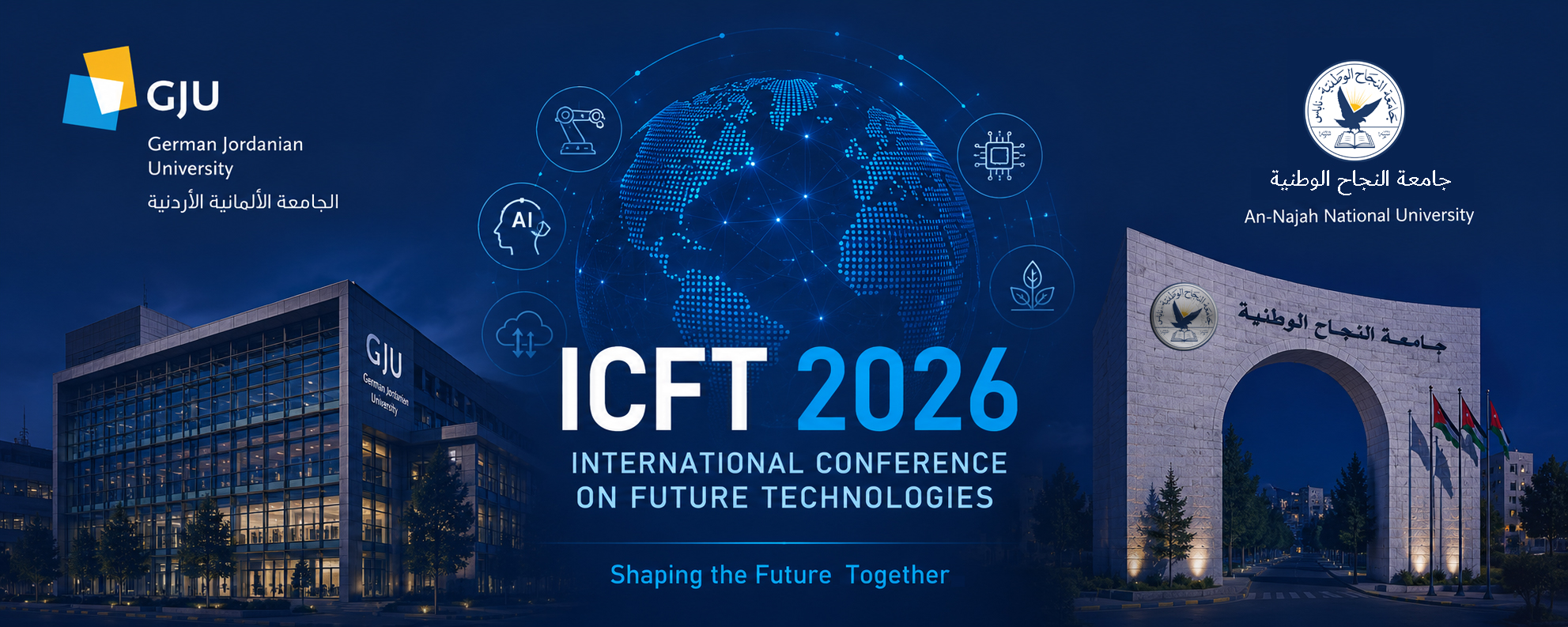
The International Conference on Future Technologies (ICFT 2026) is a premier international forum hosted by the German Jordanian University (GJU) in Amman, Jordan, bringing together leading researchers, innovators, industry experts, and policy stakeholders to shape the next era of engineering and digital transformation.
ICFT 2026 is designed to highlight breakthrough research and impactful technologies across diverse areas, including Artificial Intelligence and Machine Learning, Robotics and Autonomous Systems, IoT and Cybersecurity, FinTech and Digital Transformation, Health Informatics and Digital Health, and Smart Grids and Intelligent Energy Systems. The conference promotes interdisciplinary collaboration and emphasizes solutions that drive measurable progress in real-world environments toward smarter, safer, and more sustainable societies.
By serving as IEEE platform that bridges high-quality academic research with real-world applications, ICFT 2026 strengthens Jordan’s role as an emerging hub for future technologies in the MENA region, aligned with international scientific standards and global innovation trends. The conference welcomes original contributions that advance the state of the art, stimulate scientific dialogue, and enable stronger connections between academia and industry.
Accepted and presented papers will be submitted for publication in the IEEE Xplore Digital Library and indexed in Scopus, subject to IEEE quality requirements. In addition, selected high-quality papers will be invited to submit extended versions for consideration in Q1-ranked journals.
We warmly invite researchers, practitioners, and innovators worldwide to join us in Amman for ICFT 2026, where ideas become technologies, and technologies shape the future.
German Jordanian University (GJU), Amman, Jordan | October 18–22, 2026
ICFT| [email protected]
Honorary Committee
|
Prof. Dr. Ala’aldeen Al-Halhouli |
President of the German Jordanian University |
|
Prof. Dr. Teena Hassan |
Vice President International Affairs and Digital Transformation at Hochschule Bonn-Rhein Sieg |
|
Prof. Dr. Abdel Naser Zaid |
President of An-Najah National University |
General Chair
|
Raed Meshleh |
German Jordanian University |
International Steering / Advisory Committee
|
Osama Saadeh |
Dean of Scientific Research, German Jordanian University |
|
Marco DI RENZO |
Paris-Saclay University – CNRS and CentraleSupelec |
|
Daniel Benevides da Costa |
King Fahd University of Petroleum & Minerals |
|
Murat Uysal |
New York University Abu Dhabi |
|
Khalid Qaraqe |
Hamad Bin Khalifa University |
|
Werner Henkel |
Constructor University Bremen |
|
Filippo Sanfilippo |
University of Agder |
|
El-Hadi Aggoune |
University of Tabuk |
|
Axel Sikora |
Hochschule Offenburg |
|
Aamir Ahmad |
University of Stuttgart |
|
Ahmed Nabil Belbachir |
Norwegian Research Centre |
|
Christian Klaes |
Ruhr University Bochum |
|
Sen Cheng |
Ruhr University Bochum |
|
Pedro Lima |
Institute for Systems and Robotics, University Lisbon |
|
Ghassan Karame |
Ruhr University Bochum |
|
Issa Batarseh |
University of Central Florida |
|
Alan Mantooth |
University of Arkansas |
|
Tom Gedeon |
The Australian National University |
|
Hong Yan |
City University of Hong Kong |
|
MengChu Zhou |
New Jersey Institute of Technology (USA) |
|
Giancarlo Fortino |
University of Calabria |
Joint Strategic Organization Committee
|
Sahar Qadan |
Vice Dean of Scientific Research, German Jordanian University |
|
Marco DI RENZO |
Paris-Saclay University – CNRS and CentraleSupelec |
|
Daniel Benevides da Costa |
King Fahd University of Petroleum & Minerals |
|
Tadahiko Murata |
Osaka University |
|
Jungpil Shin |
The University of Aizu |
|
Jehan Batarseh |
National Cybersecurity Center |
|
Alaa Kasasbah |
National Cybersecurity Center |
|
Rabi Aladwan |
National Cybersecurity Center |
|
Rawan Abdelrahman |
German Jordanian University |
|
Murad Samhouri |
German Jordanian University |
|
Anass Al Ksasbeh |
German Jordanian University |
|
Bashar Almazrawi |
German Jordanian University |
|
Abdullah Alfarrarjeh |
German Jordanian University |
|
Humda Qamar |
German Jordanian University |
|
Thamer Khammash |
German Jordanian University |
|
Lana Harb |
German Jordanian University |
|
Amani Abujabal |
German Jordanian University |
|
Maysa Ammouri |
German Jordanian University |
|
Gheath Bader |
German Jordanian University |
|
Karma Kanaan |
German Jordanian University |
|
Shatha Alfraij |
German Jordanian University |
|
Wajdi Khalil |
German Jordanian University |
|
Orouba AbuNaseer |
German Jordanian University |
|
Mohammad Fetian |
German Jordanian University |
|
Mohammad Ayyash |
German Jordanian University |
|
Ahmad Alfalayleh |
German Jordanian University |
|
Omar Sawaeer |
German Jordanian University |
|
Nour-Elhuada AbeEldayem |
German Jordanian University |
|
Marmar Jaber |
German Jordanian University |
|
Baraa Alomaishat |
German Jordanian University |
|
Anas Toma |
An-Najah National University |
|
Manar Qamhieh |
An-Najah National University |
|
Muhannad Haj Hussein |
An-Najah National University |
Technical and Scientific Program Committee (TPC)
|
Saud Althunibat - Chair |
Princess Sumaya University For Technology |
|
Anas Atieh - Co Chair |
German Jordanian University |
|
Shui Yu, FIEEE |
University of Technology Sydney |
|
Hongwei Li |
University of Electronic Science and Technology of China |
|
Marco DI RENZO |
Paris-Saclay University – CNRS and CentraleSupelec |
|
Daniel Benevides da Costa |
King Fahd University of Petroleum & Minerals |
|
Mourad Loulou |
University of Sfax |
|
Ines Kammoun |
University of Sfax |
|
Lotfi Kammoun |
University of Sfax |
|
Hassene Mnif |
University of Sfax |
|
Ahmed Hadj Kacem |
University of Sfax |
|
Mohamed Jmaiel |
University of Sfax |
|
György Eigner |
Óbuda University |
|
Emanuele Bellini |
IEEE Technical Committee on Cyber Humanities IEEE Systems, Man, and Cybernetics Society |
|
MengChu Zhou |
New Jersey Institute of Technology (USA) |
|
Tadahiko Murata |
Osaka University |
|
Jungpil Shin |
The University of Aizu |
|
Jungpil Shin |
The University of Aizu |
|
Tom Gedeon |
The Australian National University |
|
Hong Yan |
City University of Hong Kong |
|
J. Alberto Conejero Casares |
Universitat Politècnica de València (UPV) |
|
Kenneth B. Kent |
University of New Brunswick |
|
Eirini Eleni Tsiropoulou |
Arizona State University |
|
Ankur Gupta |
Syracuse Universitys |
|
Yekaterina Strigina |
Hochschule Schmalkalden |
|
Jayabadhrinath Krushnan |
Hochschule Schmalkalden |
|
Venkata Prashanth Uppalapati |
Hochschule Schmalkalden |
|
Swaraj Tendulkar |
Hochschule Schmalkalden |
|
Niranjan Kannali Ramesha |
Hochschule Schmalkalden |
|
Nikhil Meduri |
Hochschule Schmalkalden |
|
Frank Schrödel |
Hochschule Schmalkalden |
|
Abdelkader Shaaban |
AIT Austrian Institute of Technology |
|
Andres Gomez |
Costa Rica Institute of Technology |
|
Lamya Abdullah |
Provadis-Hochschule |
|
Adnan Salman |
An-Najah National University |
|
Hamed Abdelhaq |
An-Najah National University |
|
Emad Natsheh |
An-Najah National University |
|
Othman Othman |
An-Najah National University |
|
Jehad Hamamreh |
An-Najah National University |
|
Abdallah Rashed |
An-Najah National University |
|
Mohammad Abuabiah |
An-Najah National University |
|
Bahaa Shaqour |
An-Najah National University |
|
Shatha Qamheih |
An-Najah National University |
|
Rani Shahwan |
An-Najah National University |
|
Naim Kittana |
An-Najah National University |
|
Moien Omar |
An-Najah National University |
|
Kamel Subhi |
An-Najah National University |
|
Zaid Halhouli |
Middle East University |
|
Sumukh Raghuram Bhat |
Intel, USA |
|
Stefan Rist |
Hochschule Mannheim |
|
Javad Ghofrani |
Hochschule Bonn-Rhein-Sieg |
|
Axel Sikora |
Hochschule Offenburg |
|
Jürgen Graf |
Hochschule Trier |
|
Abdelrahman EID |
An-Najah National University |
|
Hisham Elmoaqet |
German Jordanian University |
|
Mutaz Ryalat |
German Jordanian University |
|
Mariam Wajdi |
German Jordanian University |
|
Mustafa Shawaqfeh |
German Jordanian University |
|
Rafat Alwaked |
German Jordanian University |
|
Ammar Gharaibeh |
German Jordanian University |
|
Ghaith Alrefai |
German Jordanian University |
|
Mahmoud Alsarayreh |
German Jordanian University |
|
Nadia AL-Rousan |
German Jordanian University |
|
Jamal Alqundus |
German Jordanian University |
|
Aziz Madi |
German Jordanian University |
|
Nesreen Alsharman |
German Jordanian University |
|
Rana Almahmoud |
German Jordanian University |
|
Jumana Ma'touq |
German Jordanian University |
International Conference on FutureTech 2026 (ICFT) invites the submission of original, high-quality research papers that contribute novel research, demonstrate rigorous methodology, and present significant findings in the following areas:


International Conference on Future Technologies (ICFT 2026)
Amman, Jordan
October 2026
Contact: [email protected]
Paper Submission & Review Process (Microsoft CMT)
The ICFT 2026 paper submission and peer-review process will be conducted entirely through the Microsoft Conference Management Toolkit (CMT) system. All authors must create or log into their Microsoft CMT account to submit and manage their papers.
CFT 2026 – Author Kit
Submission Guidelines
Complete a Properly Formatted Paper
Papers should be formatted for standard A4 size paper using conference templates:
- Word Template: Word
- Latex Template: zip folder
For more information, refer to: http://www.ieee.org/conferences_events/conferences/publishing/templates.html
Use the following guidelines when preparing your paper:
Paper Length
- Maximum: 6 pages
- Up to 8 pages allowed (extra page fees apply)
- Papers exceeding 8 pages will not be reviewed
Language
All submissions must be written in English.
Format
ICFT 2026 follows IEEE format (A4). Use official Word or LaTeX templates.
Formatting Requirements
Formatting Requirements- A4 size (210 × 297 mm)
- Two-column IEEE format
- Times New Roman font
- All fonts embedded
- No page numbers
- Abstract: 75–150 words
- 4–6 keywords
- PDF format only (≤ 4 MB)
- No document security restrictions
How to Submit via Microsoft CMT
- Step 1: Log in or create a Microsoft CMT account. (Microsoft CMT)
- Step 2: Click "Create New Submission."
- Step 3: Enter paper title, abstract, keywords, track, and all co-authors.
- Step 4: Upload your PDF file and submit.
After submission, CMT will generate a Paper ID. Use this ID in all correspondence.
Download the Submission Guide
Review Process
ICFT 2026 uses a double-blind peer-review process. Each paper will be evaluated by at least three reviewers based on originality, technical quality, relevance, clarity, and contribution.
Camera-Ready Submission
Accepted papers must be revised according to reviewer comments, verified for -IEEE Xplore compatibility via IEEE PDF eXpress, and re-uploaded to Microsoft CMT before the deadline.
IEEE PDF eXpress
All final manuscripts must be IEEE Xplore compliant. Upload your paper to IEEE PDF eXpress for verification before final submission in CMT.
Copyright Form
All accepted papers must complete the IEEE Electronic Copyright Form (eCF). Instructions will be provided through Microsoft CMT.
Registration Requirement
At least one author must register before the Author Registration Deadline for the paper to appear in the proceedings and be submitted to IEEE Xplore.
Presentation
Accepted papers require a 15-minute oral presentation or a poster presentation if assigned. Presentation files must be uploaded via Microsoft CMT before the conference.
Publication
Accepted papers will be submitted for inclusion in Scopus index proceeding and publication in IEEE Xplore, subject to IEEE quality and scope requirements. ICFT 2026 follows the IEEE No-Show Policy.
Authors of selected high quality papers will be invited to submit extended versions to a Q1-ranked journal.
ICFT 2026 – CMT Submission Guide for Tutorials
Purpose: This guide explains what to prepare and how to submit (via Microsoft CMT) tutorial proposals for ICFT 2026.
Tutorials – What to submit
Tutorial proposals are submitted in CMT under the track: Tutorials. You can upload 1–3 files (doc/docx/pdf), up to 10 MB each, then answer the tutorial questions in the form.
What to prepare before opening CMT
- A detailed outline with timing (half-day 3 hours or full-day 6 hours).
- Optional supporting material: slides outline, demo screenshots, dataset/software links, or prior delivery evidence.
- Your CMT tutorial form already contains the evaluation-relevant questions. Use the structure below in your uploaded proposal document so the answers are easy to find:
| CMT Question / Field | What reviewers expect to see |
|---|---|
| Tutorial Title | Clear, concise, descriptive. |
| Tutorial Type | Half-Day (3 hours) or Full-Day (6 hours). |
| Presenter Information | Names, affiliations, emails, and 150–200-word bios. |
| Tutorial Abstract (250–300 words) | Motivation, scope, relevance, expected outcomes. |
| Learning Objectives | 3–5 measurable outcomes (e.g., "participants will be able to…"). |
| Target Audience & Prerequisites | Who it is for and the required background. |
| Detailed Outline & Schedule | Timed agenda; include breaks; show hands-on vs lecture time. |
| Content & Delivery Style | Methods, tools, demos, exercises, software, and datasets. |
| Relevance to ICFT 2026 | State which ICFT core tracks it aligns with. |
| Previous Delivery (optional) | Where/when it was delivered and attendance (if applicable). |
| Additional Information (optional) | Industry involvement, open-source repo, benchmark/challenge tie-in, etc. |
Step-by-step: Submit a tutorial proposal in Microsoft CMT
- Log in to Microsoft CMT for ICFT 2026.Microsoft CMT
- Click "Create New Submission".
- Select Track: Tutorials.
- Fill in "Title" and "Abstract" (this is the submission-level metadata).
- Add co-authors / co-presenters in the Authors section (add at least the main presenters).
- Upload your proposal document under Files (1–3 files; prefer a single .docx proposal; optional 1–2 appendices).
- Complete the "Additional Questions" (Tutorial Title, Type, Presenter Info, Abstract, Objectives, Audience, Outline, Delivery Style, Relevance, etc.).
- Save and "Submit" (ensure the status indicates the submission is complete).
Tip: Keep the uploaded proposal and the Additional Questions consistent. Reviewers typically rely on both.
How tutorials are judged (recommended criteria)
- Relevance to ICFT 2026 tracks but not limited to.
- Clarity of learning objectives and outcomes.
- Appropriate technical depth for the target audience, with clear prerequisites.
- Quality and feasibility of the outline (timing, balance, hands-on components).
- Presenter expertise and ability to deliver (bio evidence, past tutorials if available).
- Practical value: tools, demos, datasets, reproducible materials.
ICFT 2026 – CMT Submission Guide for Special Sessions
Purpose: This guide explains what to prepare and how to submit (via Microsoft CMT) special sessions proposals for ICFT 2026.
Special Sessions – What to submit
Special Session proposals are submitted in CMT under the track: Special Sessions. We recommend a concise PDF (~2 pages) that includes enough detail for fair evaluation.
Special Session proposal format (recommended ~2 pages PDF)
- Special Session Title + Acronym (if any)
- Organizers (names, affiliations, emails) + short organizer bios (3–5 lines each)
- Motivation and timeliness (why now; what gap it fills)
- Scope and topics (bullet list of themes; include "in scope" and optionally "out of scope")
- Format plan (e.g., 4–6 invited talks + panel/Q&A; or mixed invited + contributed papers)
- Tentative speaker list (if confirmed) OR a plan to recruit speakers (if "TBA")
- Expected audience and impact (research + industry; community-building goals)
- Relevance to ICFT 2026 tracks (explicit mapping to 1–2 core tracks)
- Session logistics (estimated duration, equipment needs, hybrid needs if any)
- Diversity and balance plan (geography, gender, academia/industry), where feasible
Step-by-step: submit a Special Session proposal in Microsoft CMT
- Log in to Microsoft CMT for ICFT 2026. Microsoft CMT
- Click "Create New Submission".
- Select Track: Special Sessions.
- Enter a clear Title and a short Abstract that summarizes the theme and format.
- Add the organizer team as authors (at least the main organizers).
- Upload the proposal as a single PDF (recommended ~2 pages). You may upload up to 3 files if you have an appendix.
- Submit and confirm that the submission is marked complete.
How special sessions are judged (recommended criteria)
- Fit with ICFT 2026 themes and clear differentiation from the main tracks.
- Timeliness and technical relevance (why this session matters now).
- Quality of organizer team and feasibility to execute (clear plan, realistic format).
- Breadth and community value (brings people together; interdisciplinary if relevant).
- Speaker/participation plan (confirmed speakers OR credible recruitment plan).
- Expected attendance and impact (research + industry engagement).
- Clarity and completeness of the proposal (easy to evaluate fairly).

Author Registration
|
Category |
Fees |
|
Author Rate |
450 Euros |
|
IEEE Member Author Rate |
400 Euros |
|
Student Author Rate |
200 Euros |
|
IEEE Student Member Author Rate |
150 Euros |
|
One Extra Paper (same author, maximum two papers per non-student author) |
Half Rate |
|
Extra Page (beyond 6 pages, up to 2 additional pages) |
50 Euros per page |
-
The author rates cover registration for one paper and one author attendee.
-
An author registration also entitles the attendee to receive one copy of the Proceedings, two Lunch Tickets and one Gala Dinner Ticket.
-
Student Authors are authors who are undergraduate or graduate students.In order to enjoy this rate, the student must provide a proof that he/she is a student.
-
For the extra paper, the additional registration fees is half the rate of the registered author. This additional fees apply to the same author that registered at any of the above non-student rates and does not cover additional attendees. In this case, the register author must be author in both papers.
-
Although not encouraged, authors can have papers longer than 6 pages, but not exceeding 8 pages. Each of the extra two pages costs 50 Euros.
Attendee Registration
|
Category |
Fees |
|
Attendee Rate |
250 Euros |
|
IEEE Member Attendee Rate |
200 Euros |
|
Student Attendee Rate |
150 Euros |
-
An Attendee registration entitles the attendee to receive one copy of the Proceedings and two Lunch Tickets.
-
Student attendees must present a valid student ID card at the on-site registration desk.
Contact Information
 Address
German-Jordanian University (GJU), Amman Madaba Street, P.O. Box 35247, Amman, 11180, Jordan
An-Najah National University (NNU), Nablus, West Bank, Palestine, P.O. Box 7
 Email
Email
 LinkedIn
Latest News and Activities
 22 Jul 2026⏳ TIME IS RUNNING OUT! ⏳